
Tuesday, September 30, 2014


Monday, September 29, 2014
Hudson's heritage remains safe
 |
| Mr. Forsdick mislabeled his otherwise handsomely Photoshopped images. The existing house is actually the one on the right. |
The HPC quickly and unanimously voted down the petition, and vented its considerable indignation. "Our heritage is at stake," sniffed one commissioner, summarizing the views of her peers. "This is an historic facade. To disrupt the three-rank rhythm would present a threat to the very foundation of our society."
"The mere suggestion of altering this facade in this manner has made me queasy," said another commissioner. "Although it could be the German breakfast quesadilla I had at Bob's," he added before excusing himself from the proceedings.
A tumultuous, forty-five minute argument ensued between the remaining commissioners and the petitioner. It quieted down only upon the petitioner's realization that he had inadvertently reversed his existing and proposed images. The picture he had labeled "existing" was in fact the "proposed" version of the house, and vice versa. Mr. Forsdick apologized sheepishly and profusely to the panel. What he really wanted, he explained in halting English to a now silent audience, was to install a new window above his front porch where there currently is a blank wall, in order to create a more balanced facade and introduce natural light into his dressing room.
With the new information in hand, the Commission voted a second time against the petition. "This is an historic facade," explained a commissioner. "To disrupt it would threaten the very foundation of our society." "Our heritage is at stake," reminded a second commission member. The missing HPC member returned to the room in a state of visceral upset. "I have read that this kind of thing can lead to the mutilation of babies," he added.
A mild but distinct scent, similar to that of a fresh lilac bloom onto which a domestic shorthair has dropped a major dookie, wafted through the chamber, and the meeting was adjourned.
Saturday, September 27, 2014
Found in Hudson
These and several other childhood mementos from the late 70s to early 80s were found behind a cupboard in a house on Union Street in Hudson. Perhaps someone out there knows the man and woman these two have since become.


Friday, September 26, 2014
Progress comes to Progress
 |
| Hay harvest, Progress, Pennsylvania |
The only remaining farm in Progress (pronounced with a long "o"), Pennsylvania, awaits the encroachment of suburban sprawl.
Thursday, September 25, 2014
Curb enthusiasm
 |
| At the park's western corner, the boundaries between pedestrian, car, and rail zones are poorly defined. |
The park's western corner is a good place to start. My informal but repeated observations indicate that this is the busiest corner of the park and the entry point for the majority of park users. Unfortunately, the rail line that infamously crosses the park slices through this corner, smearing the distinctions between the pedestrian, motor vehicle, and rail realms. The sidewalk and curb dissolve into asphalt which dissolves into the rail right-of-way which dissolves into active lanes of traffic; where is one to safely stand while waiting to cross the street? There are no barriers to guarantee refuge, and the physical and psychological assault comes from more directions than can be confidently monitored. The situation is only slightly better for those approaching the corner from the other side of the street, where the awkward boundaries combine with other poor physical cues to present a picture that on good days is ambiguous, and more often is repellent.
A simple curb bumpout at this corner would solve much of the problem by providing a larger, clearer pedestrian zone. Here are two existing bumpouts:
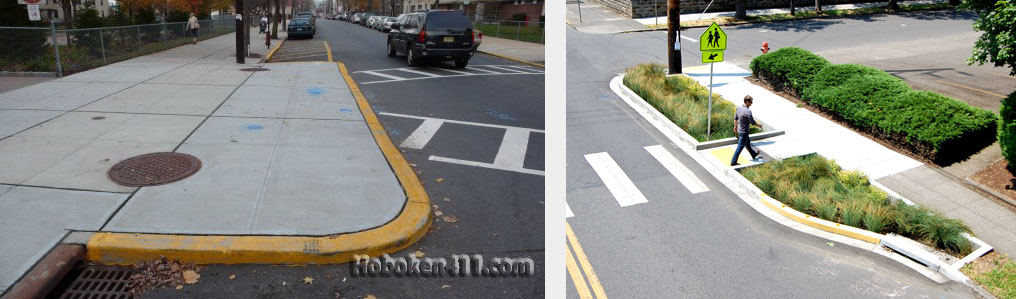 |
| Left: a basic curb bumpout in Hoboken, New Jersey (photo from hoboken411.com). Right: a landscaped example in Seattle, Washington (photo from myballard.com). |

 |
| GIF animation may not work in some mobile browsers. |
You might notice that I've continued the one-way traffic on Seventh Street into the next block heading southwest (lower left in diagram). At present, this block is ridiculously, if pleasantly, complex: the street is narrow, there's a train running down one side of it, there's pull-in parking on the other side, and there's two-way traffic. There might be a reason for this last aspect that I cannot surmise, but my working assumption is that a one-way accommodation will be adequate because Sixth Street already flows in the opposite direction. Ultimately, this is a question on which to consult the traffic engineers.
Putting all this together, I've suggested below some possible changes to the curb boundaries of the park. The sidewalks are wider and the crosswalks to the park are shorter than at present. Parking has been maintained around the entire perimeter. The biggest license I took was in showing pull-in angle parking on Park Place; I'm not sure there is enough space.

If the irregular curb geometries look odd to your eye, it likely is due to the abstract nature of the drawing. In the real world, you've almost certainly encountered similar curb shapes many times without such concerns arising.
For now, I've represented the park with an expanse of green. This does not indicate a design intent but the absence of one. I'll continue my sporadic investigations into what might happen inside the park's boundaries another time.
Tuesday, September 23, 2014

Monday, September 22, 2014
Counting blue vans
 |
| 1955 Ford Step Van, Saugerties, New York |
 |
| The same van in Cincinnati, Ohio. Image: collectorcarads.com |
The van lacked badging, and I'm not good at sight-identifying cars built before about 1950 or trucks of any era. When I returned to my office, I Googled "step van." The first page of images included an advertisement for a 1955 Ford Step Van. It was this very vehicle, for sale last year in Cincinnati. An intrepid soul apparently drove it 750 miles to its current resting spot. I wouldn't be comfortable driving it a tenth that distance, but it does look like it would make a very cool and serviceable urban food truck.
Take it away, Dishwalla.
Thursday, September 18, 2014
A crown for Warren Street
 |
| Above: Route 9 (solid line) currently jughandles through Hudson because a narrow, two-block section of roadway prevents a simpler, straighter route (dashed line). Below, the existing intersection of Warren Street with Worth and Prospect.  |
In a recent post, I looked into rerouting U.S. Route 9 as a way of reducing truck traffic within the Hudson street grid. I raised the possibility of simplifying the route by widening a narrow, two-block stretch of Prospect and Fairview Avenues, and as an additional option, merging Prospect and Fairview into a continuous street.
In this post I'll look at the intersection where my rerouting began, the meeting of Warren Street with Prospect Avenue and Worth Avenue. Some Hudsonians complain about this intersection because of the three-way stop signs. Personally, I find communal value in the eye contact and informal coordination they call for, but at rush hour, when I almost never drive, such charms are perhaps lost.
Whether or not the intersection is a failure from a traffic standpoint, it is most definitely a failure from a civic standpoint. This is an important intersection in Hudson. It marks the head of Warren Street, the cultural and commercial spine of the city, a street celebrated for its architecture, restaurants, and galleries. But while the bottom end of Warren Street is anchored by a promontory overlooking the Hudson River, here there is no indication of the street's significance. There is no major building or space to complete the street axis and pull walkers to its top end; the strongest architectural gestures are an auto repair garage and a marginally maintained, 1870-ish flop house. Besides presenting a significant aesthetic problem, this represents an economic and cultural problem, as properties at this end of Warren Street have tended to languish.
 |
| Warren Street is the commercial and cultural spine of Hudson. It is is
received by a park at the Hudson River, but it lacks a significant marker at its upper end. |
Below I offer a suggestion for anchoring the top of Warren Street. I've realigned Prospect and Worth Avenues into a continuous street, and extended Warren to meet them in a T. I also rerouted the alley behind Worth Avenue to connect with Prison Alley. These changes would result in the loss of two houses (one architecturally undistinguished) and the auto repair garage. The gain is a clear beginning/end to Hudson's main street and a large, developable parcel to the southeast.
 |
| A street realignment and new building and plaza offer a civic gesture at the head of Warren Street. |
 |
| Portland, Maine |
Subscribe to:
Posts (Atom)